Tech · 10 min read
Tech Jobs Without Coding: Is It Too Late? 33,130 Fresher Jobs Say No
I went through Naukri's fresher job posts for 8 tech roles that don't need daily coding, and here's which roles are hiring, what they really pay, and how people actually got in.
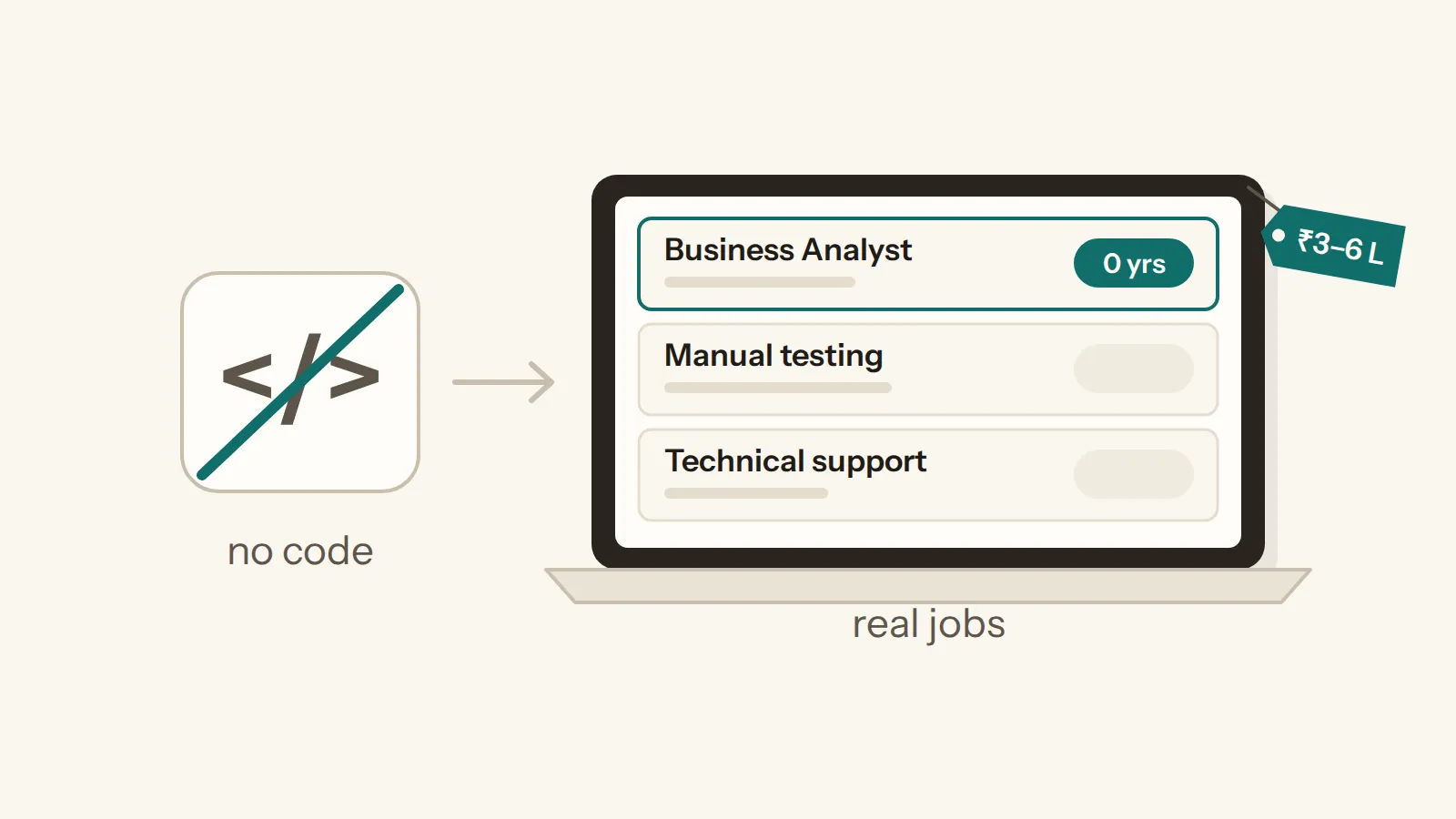
In short: No, it isn't too late. Naukri had more than 33,000 fresher jobs for tech roles that don't need daily coding, and in every role the 3–6 lakh band had the most jobs. Business Analyst wants freshers the most, and support is the biggest door but mostly BPO work.
If you studied BTech, BCA or MCA and coding never clicked for you, you've probably read a line like this on Reddit: "Bro you are 5 years late. People who can do coding can't find jobs, so definitely tough to find no coding jobs without any other skill." It sits in a thread on r/developersIndia with plenty of upvotes, and maybe you agreed with it at 2 am.
So I went to Naukri and looked at tech jobs without coding, only the ones that are open to someone with 0 years of experience. And they added up to 33,130 jobs, which is not what "too late" looks like.
But the same job posts also show where the traps are, so let's go through it one reason at a time.
Reason 1: the jobs exist, 33,130 of them
The biggest doors are support and testing, so if you just want a first job with a tech title, that's where most of the openings are.
Where the fresher jobs are (Naukri, 11 October 2026)
- Technical support: 17,689
- Manual testing (QA): 7,019
- UI/UX designer: 3,609
- Data analyst: 2,888
- Business Analyst: 1,145
- Cyber security: 436
- Project coordinator: 295
- SAP consultant: 49
But "open to freshers" on Naukri is a bit loose, because it also picks up posts like one that asked for anywhere from 0 to 13 years. So I looked closer at the first page of each role and kept only the jobs that are really meant for someone new, up to 2 years.
And here the order changes. Business Analyst came out on top, with 13 out of 20 jobs meant for freshers, and testing came a close second, while cyber security wanted freshers the least.
One more thing before you dream of working from your bedroom: nearly all of these jobs are in an office, and SAP consultant was the only role with a real share of remote jobs.
Reason 2: they pay 3–6 lakh, not 35
You may have seen pages about non-coding jobs throw around ranges as wide as "8 to 35 LPA", without saying where the number comes from.
Naukri's own salary filter tells a calmer story, and it's the same story for all 8 roles: the most jobs sit in the 3–6 lakh band, and in most of them the next biggest group is 0–3 lakh.
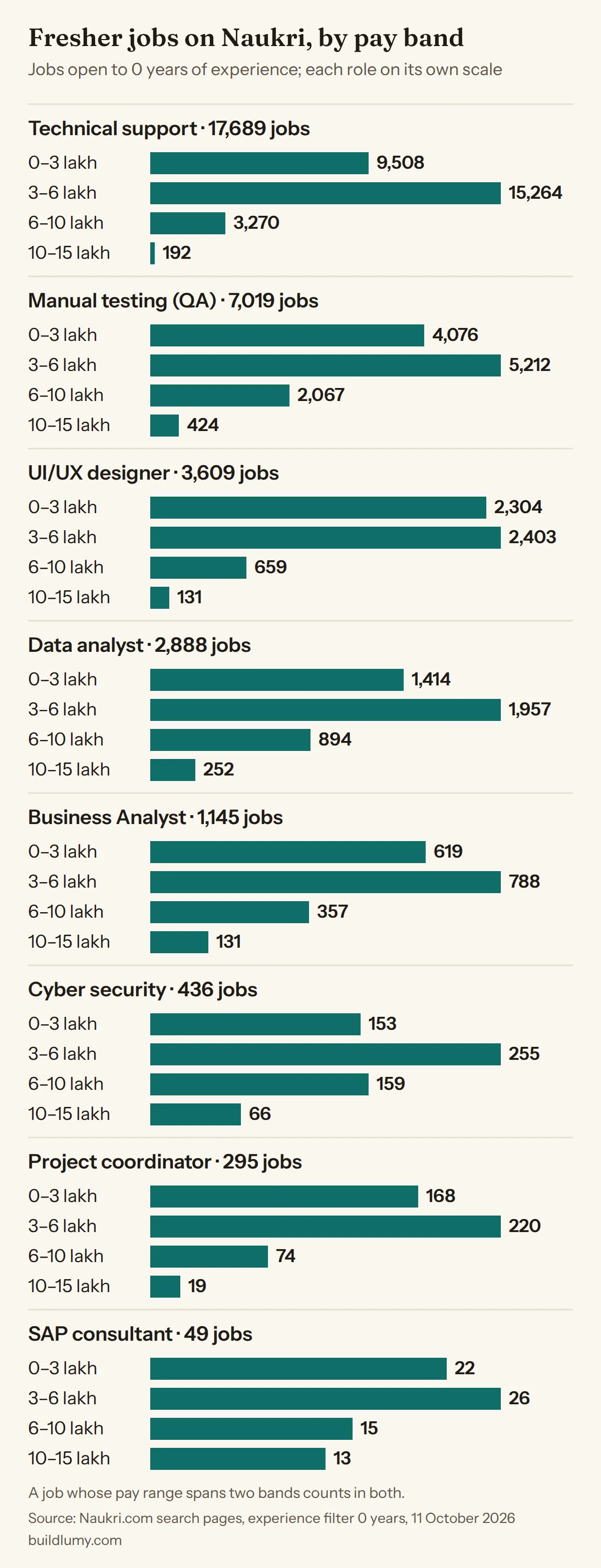
The chart counts a job once in every band its pay range touches, so a "2–7 lakh" job shows up in two bars. That's why the bars show where the pay sits, not how many separate jobs there are.
And most companies don't tell you the pay up front. Only about 1 in 5 of the job posts I looked at showed a salary at all, so you'll be asking about it in a lot of interviews.
Even Google's AI answer, when I checked, said you can build a strong, high-paying career in tech without writing code. Maybe one day, but for a fresher the honest start is 3–6 lakh, and you grow from there.
You may also have heard about forward deployed engineers, because TCS, Wipro and Infosys, which calls them frontier engineers, are all building teams of them. They're engineers who work inside a client's business and build AI tools around its real problems, and TCS alone wants up to 8,900 of them.
But whatever these jobs pay, they aren't jobs without coding. One of Wipro's posts for the role, in the US, asks for Python, JavaScript and 8–10 years of experience, and Infosys says it'll fill its seats mostly by training its own people and the graduates it hires from college. So for a fresher who doesn't code, it isn't a door.
What carries over is the client part, though, because understanding a client's problem and explaining what to build is a big part of a Business Analyst's job too.
Reason 3: you get in with proof, not just certificates
Here's the odd part. If you only read the job posts, you'd think nobody cares what you've built, because not one of the posts I read named an AI tool like ChatGPT, or a portfolio.
But listen to the people who actually got in. A woman who became a data analyst after a long career break, and years of BPO support before that, said "half of the calls were because of reference". And when HR called, one of the questions was "Do you have a portfolio?", as she tells in her interview with LearnWidGiggs.
Some of her calls came from projects she kept posting on LinkedIn, and the job itself came through a referral from a community she volunteered in.
If you've been applying and hearing nothing back, I've written about what stands between you and a real job, from ghost jobs to AI filters, in Why You're Not Getting Interview Calls in 2026.
A Maths graduate who became a fresher Business Analyst tells a similar story. She learned Excel, Power BI and a project tool called Jira, put two small projects on her resume, and got the job within a few months.
And how she found it says a lot about speed: the job post was open for barely half an hour before dozens of people had applied.
That's why I think this matters so much now: because of AI, it's essential to build things with careful planning, and with AI you can create software projects, solve real problems and get into tech jobs. AI can help you build the proof, but the planning, the checking and the explaining are yours, and that's what you'll be talking about in the interview.
My own Google apprenticeship interview went wrong because of how I explained my work, and I wrote down what I'd say now in How to Explain Your Work in an Interview.
The 8 roles compared
Before the table, here's my rule for "without coding": a role counts if a fresher doesn't write programs as the main job. Then each role gets a code level from the skill tags in its own job posts, so you know what you're signing up for.
Code levels: none · a little (SQL or Excel in the tags) · some (Python or test automation in the tags)
Quick table: tech jobs without coding, freshers, Naukri, 11 October 2026
| Role | Jobs open to freshers | Truly fresher (page 1) | Most jobs in | Code level | Note |
|---|---|---|---|---|---|
| Technical support | 17,689 | 7 of 20 | 3–6 lakh | none | mostly BPO work |
| Manual testing (QA) | 7,019 | 12 of 20 | 3–6 lakh | some (test automation) | |
| UI/UX designer | 3,609 | 9 of 20 | 3–6 lakh | none | |
| Data analyst | 2,888 | 6 of 20 | 3–6 lakh | some (Python) | |
| Business Analyst | 1,145 | 13 of 20 | 3–6 lakh | a little (SQL, Excel) | most fresher jobs |
| Cyber security | 436 | 4 of 20 | 3–6 lakh | none | |
| Project coordinator | 295 | 9 of 19 | 3–6 lakh | none | |
| SAP consultant | 49 | 7 of 20 | 3–6 lakh | none | few openings |
Details table: what the job posts ask for
| Role | Skills the posts tag most | Pay shown (page 1) | In an office |
|---|---|---|---|
| Technical support | BPO non-voice, international non-voice, customer service, email and chat support | 2 of 20 posts | 98.6% |
| Manual testing (QA) | manual testing, test cases, regression testing, automation testing | 2 of 20 posts | 95.0% |
| UI/UX designer | UX, UI, user interface design, Photoshop, Adobe XD, research | 0 of 20 posts | 96.4% |
| Data analyst | data analysis, Python, Power BI, SQL | 7 of 20 posts, middle about 3.1 lakh | 95.9% |
| Business Analyst | business analysis, Power BI, SQL, Excel | 7 of 20 posts, middle about 4.5 lakh | 97.3% |
| Cyber security | cyber security, vulnerability, information security, security operations | 0 of 20 posts | 92.9% |
| Project coordinator | project coordination, project documentation, administration, monitoring | 9 of 19 posts, middle about 2.4 lakh | 94.9% |
| SAP consultant | SAP, consulting, SAP MM, SAP Basis, master data | 4 of 20 posts, middle about 11 lakh | 65.3% |
Don't read too much into SAP's high pay line, though, because only a handful of its job posts showed a salary at all.
How I counted, and what the count can't tell you
I took one search page per role on Naukri on 11 October 2026, with the experience filter at 0 years, and read the total, Naukri's salary filter and the first page of job posts.
The salary filter shows its bands up to 15 lakh first, and I didn't open the higher ones. And one post can show up in more than one search, though none of the posts on the first pages did.
One more honest note: these are job posts, not people hired, and the same job can be posted more than once, as a few were on the first pages.
So it's one day, one site and one page per role. And Naukri's short previews don't show the full job description, which is why AI tools and portfolios are probably mentioned more often than this count shows.
The one reader: a fresh BTech, BCA or MCA graduate
Let's make it concrete. Say you've just finished BTech, BCA or MCA, you live in a smaller city, coding isn't for you, and you need a first job that pays at least 3 lakh a year. Which of these should you look at first?
I'd start with Business Analyst, because it wants freshers more than any other role here, and the middle of the pay its job posts show is around 4.5 lakh, above your 3 lakh.
Testing is a good second choice, since it also wants a lot of freshers, but its job posts rarely show pay, so you'll have to ask.
Data analyst pays in a similar band, but it wants Python and fewer of its jobs are really for freshers, so it's more of a next step than a first door.
And whichever role you pick, 3 lakh is a fair floor to ask for, not a dream, because in every one of them the 3–6 lakh band beats the 0–3 lakh band.
And if you're not sure yet which kind of work suits you, What Job Is Right for Me? starts with a quick quiz and a list of what you've already done.
Here's a first 90 days you can copy. Most of it is what the people above actually did, and the industry step is my own advice.
Checklist: your first 90 days
6 steps
"Non-coding" still means a little SQL and Excel
Before you take the "no coding" part too literally, there's a catch. One Reddit reply puts it plainly, Business Analyst needs a bit of SQL, and a YouTube video on Salesforce careers says the same thing: BA isn't a no-coding field, but there isn't much coding.
So expect Excel, Power BI or Tableau, and some SQL queries, even in the "non-coding" jobs.
A Hindi podcast with a Business Analyst makes the same point from the other side: in BA and QA you don't write the code, but you should know how the application is built. And the advice there is to give coding a fair try first, six months to a year, before you decide it isn't for you.
It's not only an Indian thing either. Someone on a US forum who had just landed a fully remote helpdesk job said the only coding they do is in the command line and PowerShell, so a little scripting is normal, and AI can help you learn it faster.
Support: the biggest door, and its trap
Support has more fresher jobs than all the other roles put together, but look at what the posts actually ask for: BPO non-voice, chat support, email support. That's mostly customer service with a tech label, and none of its top skills is coding.
The worry on Reddit is real, though. A computer science graduate asked if starting in support makes it harder to move to Business Analyst later, and one reply warned that in support, or even in BA, you might struggle to cross 10 lakh a year after 10 years. So whichever door you take, plan your next step early. Another graduate's first job was as an IT trainee in support, on a one-year contract.
And AI gives you one more reason to plan that next step early. A Stanford study of US payroll data found that the jobs most exposed to AI now have 19% fewer young workers than they'd have if they had kept up with less exposed jobs, and that's mostly because companies are hiring fewer young people, not because more of them are leaving. Customer service and computer support are on its list of those jobs, and the chat and email support in these job posts is the same kind of work. It's US data, and the authors call it an early sign, not proof that AI caused it.
So if you take a support job, and many of you will, treat it as a start, not a stop. Keep building the projects from your 90 days, because the data analyst above came out of years of BPO support with projects, LinkedIn posts and a referral.
So is it too late? Not if you go in with proof. The jobs are there, the most common pay is 3–6 lakh, and after all this it's you who has to build the projects and show them.
Tags: careers · freshers · tech jobs