AI · 6 min read · Part 1 of 3 · All parts ↓
Why You're Not Getting Interview Calls in 2026 (It's Not Just Your Resume)
Ghost jobs, "comment interested" posts, data grabbers and AI filters: what is standing between you and a real job.

In short: Many listings were never really open, "comment interested" posts rarely lead anywhere, and some offers only want your number or your money. Apply to fewer real jobs, never pay for one, and look for a referral.
If you've been looking for a job lately, you've probably noticed that job portals don't look the way they used to. On LinkedIn, Naukri, Wellfound and ZipRecruiter, roles like AI engineer and AI trainer are everywhere. Some companies now hire people just for the language they speak, like Telugu, Tamil, Gujarati or Hindi, to train AI. One listing asked native Telugu speakers to check AI-written answers for grammar and facts, fully remote, at $15 to $150 an hour (Built In).
Next to them sits the same long list of data analyst openings, and many of those turn out to be fake. And then there are the LinkedIn posts that ask you to "comment interested" and never say anything after that.
Honestly, looking for a job right now feels like drowning in a huge sea while you are sitting in a boat. You have skills, you have a degree, you have done real work, and still nothing comes back. Maybe that's exactly where you are right now.
So before we talk about what works, let's understand what this wall is made of. Once you see it clearly, you stop blaming yourself for every silent "no".
Some jobs were never open
A lot of the jobs you apply to were never really open. People call them ghost jobs.
This is not just a feeling. In a 2024 survey of US hiring managers, 40% said their company had posted a fake job listing that year, and 3 in 10 had one live at the time (Resume Builder). Greenhouse, a hiring software company, says 18–22% of the jobs posted on its platform in a quarter are ghost jobs (Greenhouse).
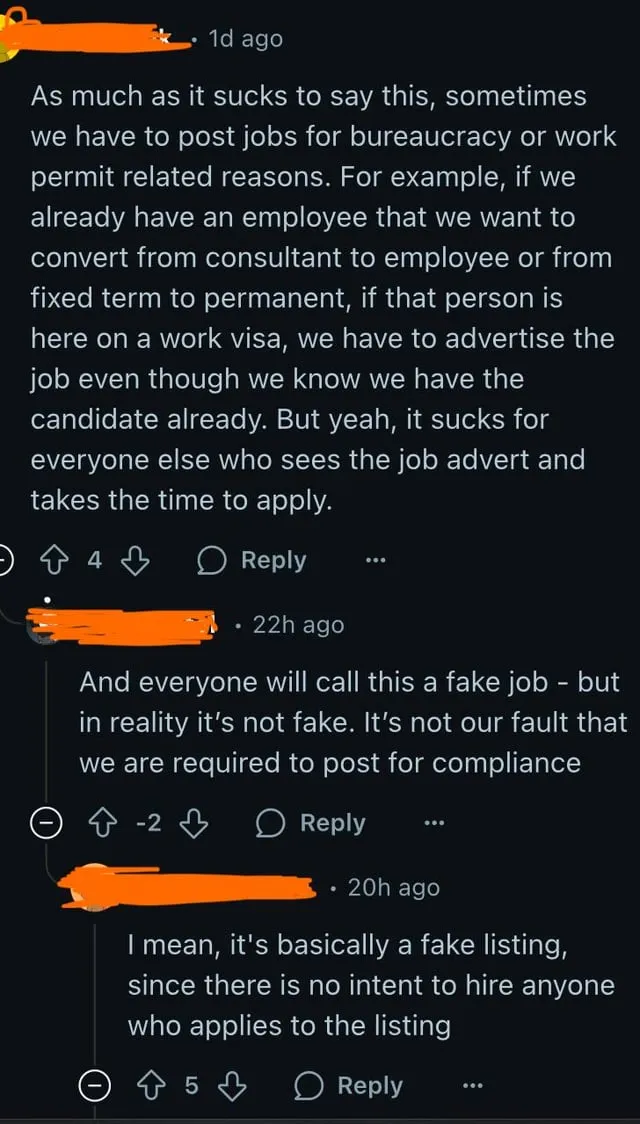
Even recruiters admit it. On Reddit, one recruiter wrote that sometimes they have to advertise a job even though they already have the person they want, just to follow a rule. Someone replied: if nobody who applies has any chance, then it's a fake job.
So if you applied to fifty jobs and heard back from two, it's not always your resume. Sometimes there was no job.
"Comment interested", and then nothing
Then come the LinkedIn posts. You've probably seen one this week: "We are hiring! Comment INTERESTED." Maybe you even commented. You updated your profile, sent your CV, and waited. And then? No call, no message, no update.
What the hell is this? To me, most of these posts are not about hiring. They are about engagement and followers. The more people comment, the bigger the post looks, and the person who posted it gets the attention. You get nothing.
I'm not the only one who is angry about it. One person wrote this in Hindi, and many people reacted to it:
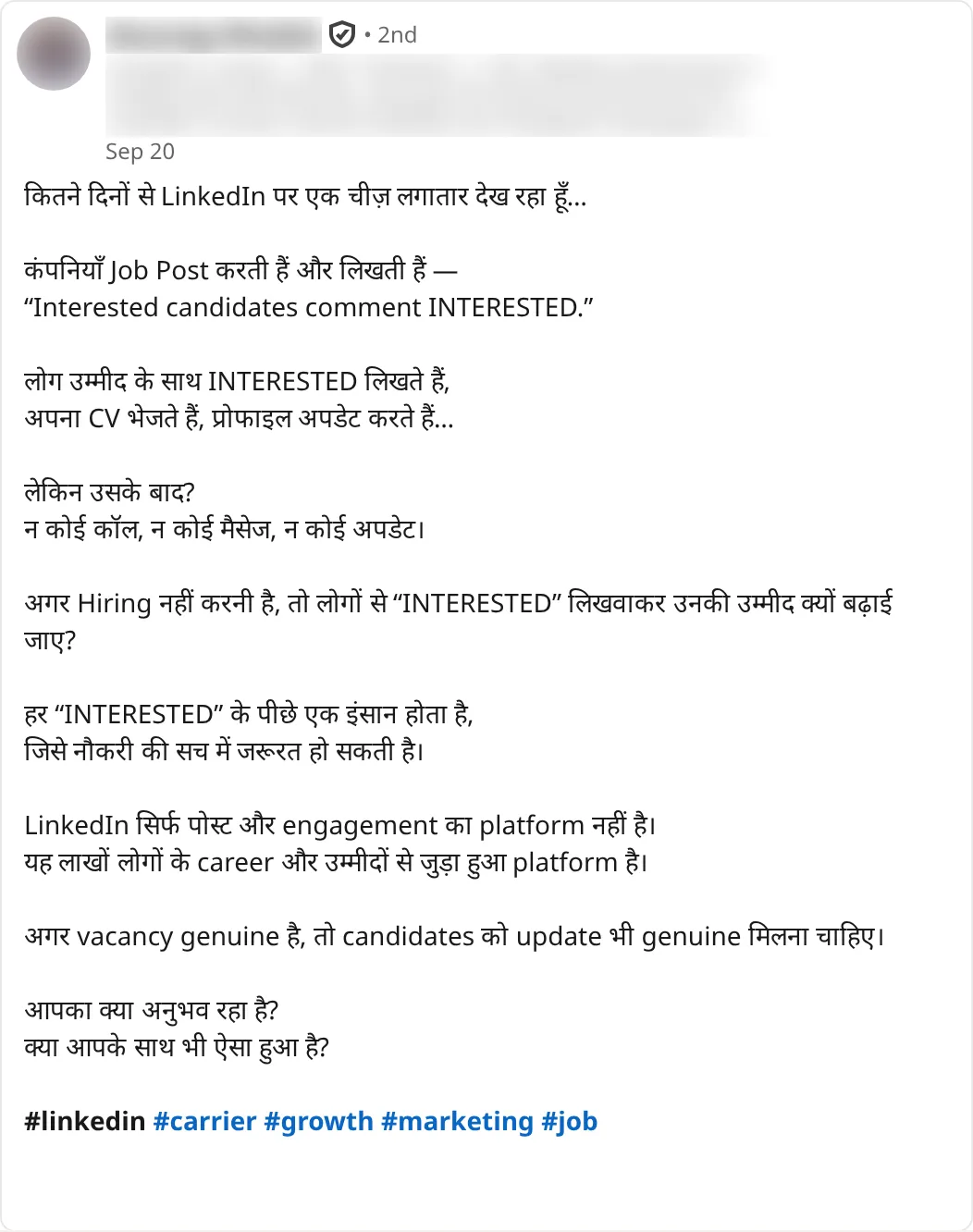
In short, they asked: if you are not hiring, why raise people's hopes? Behind every "INTERESTED" there is a person who may really need that job, maybe someone like you.
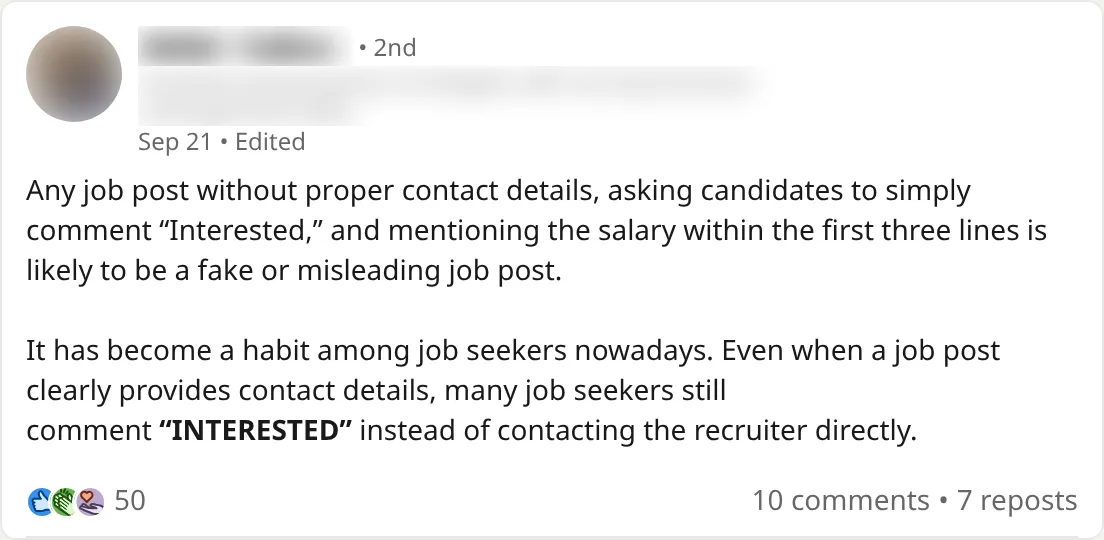
Another post gave a simple way to spot them: no proper contact details, "just comment interested", and the salary written in the first three lines. If a post has all three, don't waste your time on it.
Some jobs are only there to take your number
This one is worse. Some fake jobs are only there to collect your email and phone number. You apply, and after that the bombardment starts: ads, messages, calls. You get added to WhatsApp groups you never joined. Then you get a message about an "internship", and the first step of that internship is to pay for a course.
That is not hiring. That is selling.
One job seeker counted around 20 job offers in one month, by email, WhatsApp and calls, and every single one looked like a scam:
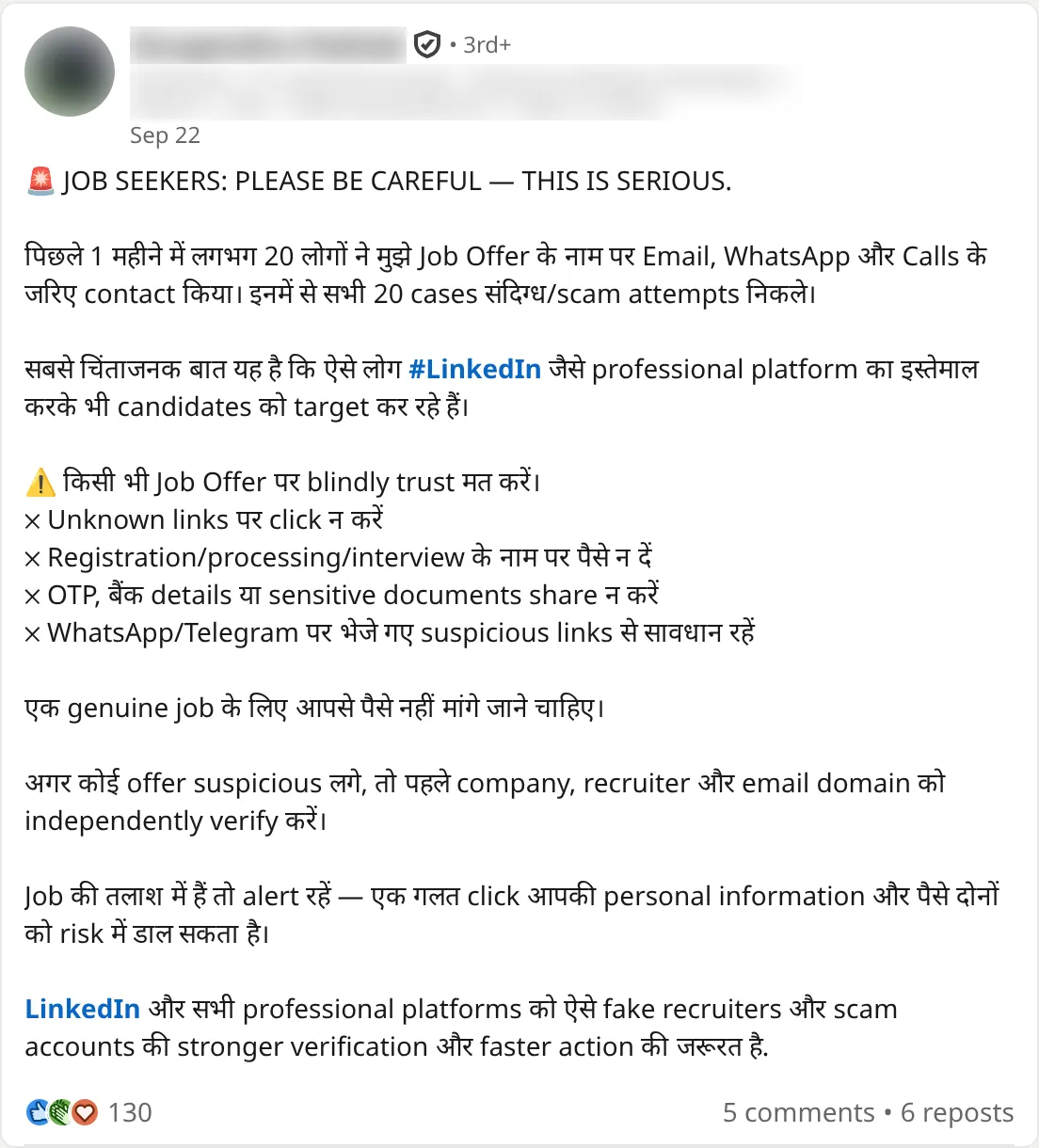
And then there is the "backdoor job". Someone you know, a senior or a relative, says they have contacts and can get you a 5 LPA or 8 LPA job if you pay ₹2–3 lakhs. As one post warning about this pointed out, many times it's the parents who lose that money. If anyone offers you this, please don't pay.
AI applying, and AI rejecting
Now the newest part of the wall. You might use AI to apply to 1,000 jobs a day, and many people do. In Greenhouse's survey, 38% of job seekers said they were mass-applying.
I don't like applying with AI, and here is why. Even if your AI reaches the 10 jobs that are right for you, those 10 companies may also be using software, more and more often AI, to cut down the pile of applications. So you send more and more applications, and fewer of them are read by a human.
Someone on LinkedIn joked that their application had said "received" for 37 days, and they just wanted the test link so the algorithm could reject them personally. We laugh, but maybe you're living exactly that right now.
So what actually works?
After all this, you might think it's hopeless. It's not. People still get interview calls and jobs every day, and what they do is quite simple. If a younger friend asked me, I would tell them:
"Bro, make a good resume. Get skilled enough to pass the interview. Find someone who works at the company you want, and ask for a referral. Then give the interview. Done."
That is the whole strategy. But two parts of it are harder than they sound.
First, you need to know which company and which job you really want, and that depends on what you are good at and what you enjoy. That's what Part 2 is about.
Second, when you finally get the interview, you have to explain yourself well. Many times I got rejected because of how I spoke and explained my ideas. In Part 3 I'll tell you about my interview for Google's project management apprenticeship, what went wrong, and give you the full checklist, with communication at the very top.
Three things to do today
- Check the job is real. Look for it on the company's own careers page. No company name, no clear role, only "comment interested"? Skip it.
- Never pay for a job. No registration fee, no course fee, no "guaranteed placement". In India, report it on 1930.
- Apply to fewer jobs, properly. Ten careful applications to the right jobs will do more than a thousand to every job.
Tags: jobs · careers · job search