Finance · 5 min read
Average Cost of Groceries per Month for 1, 2 and 4 People
What U.S. households of one, two and four people spent on groceries in 2025, and why every site gives you a different number.
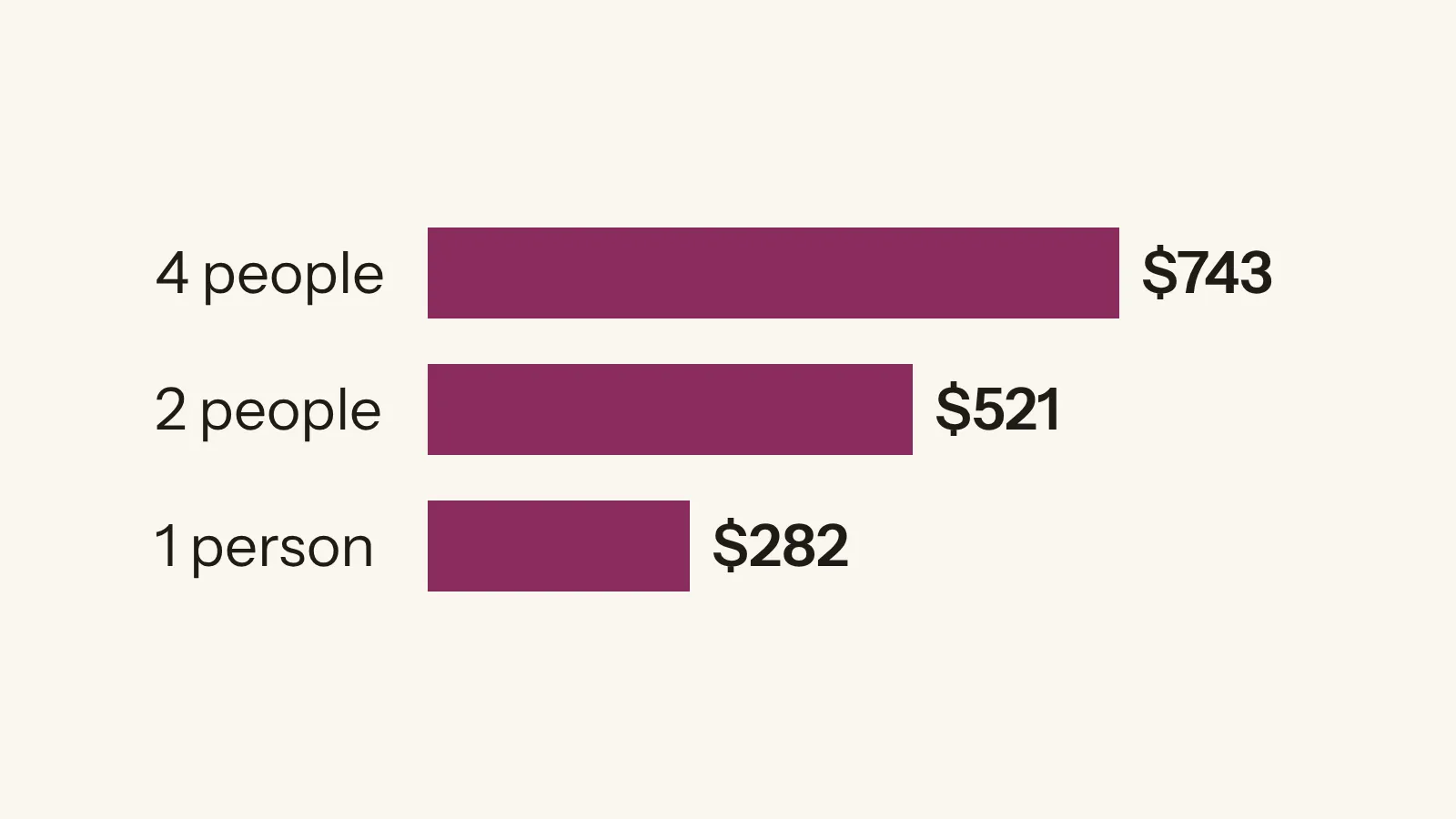
In short: Groceries a month in 2025, U.S. households (BLS): one person about $282, two people $521, four people $743. Most sites show bigger numbers because they mean something else: a USDA food plan's price, or a whole household's bill written as one person's.
Maybe you're setting a budget and want a number to aim for, or your grocery bill feels too high and you want to know if that's normal. So you search for the average cost of groceries per month, and every page on Google's first page gives you a different average, and almost none of them says which question its number answers.
The most direct answer comes from the agency whose survey asks households what they spend, the U.S. Bureau of Labor Statistics. In 2025, a household of one person spent about $282 a month on groceries, and the table below has two and four people as well.
Most sites show bigger numbers, but mostly because they answer other questions, like what a USDA food plan would cost, or what a whole household spends, written as if it were one person. So once you know which question a number answers, the numbers stop fighting each other.
What households of 1, 2 and 4 people spend
BLS's Consumer Expenditure Surveys ask households across the U.S. what they spend, and their "food at home" line is what this article calls groceries. Eating out has a line of its own, so here are both, a month, for each household size.
| Household | Groceries a month | Eating out a month |
|---|---|---|
| 1 person | $282 | $192 |
| 2 people | $521 | $349 |
| 3 people | $644 | $392 |
| 4 people | $743 | $512 |
| 5 or more people | $1,001 | $514 |
| All households (2.4 people on average) | $541 | $345 |
These are BLS's yearly averages for 2025, turned into months and rounded to the dollar, and for one, two and four people their standard error is about 5 percent of the amount or less.
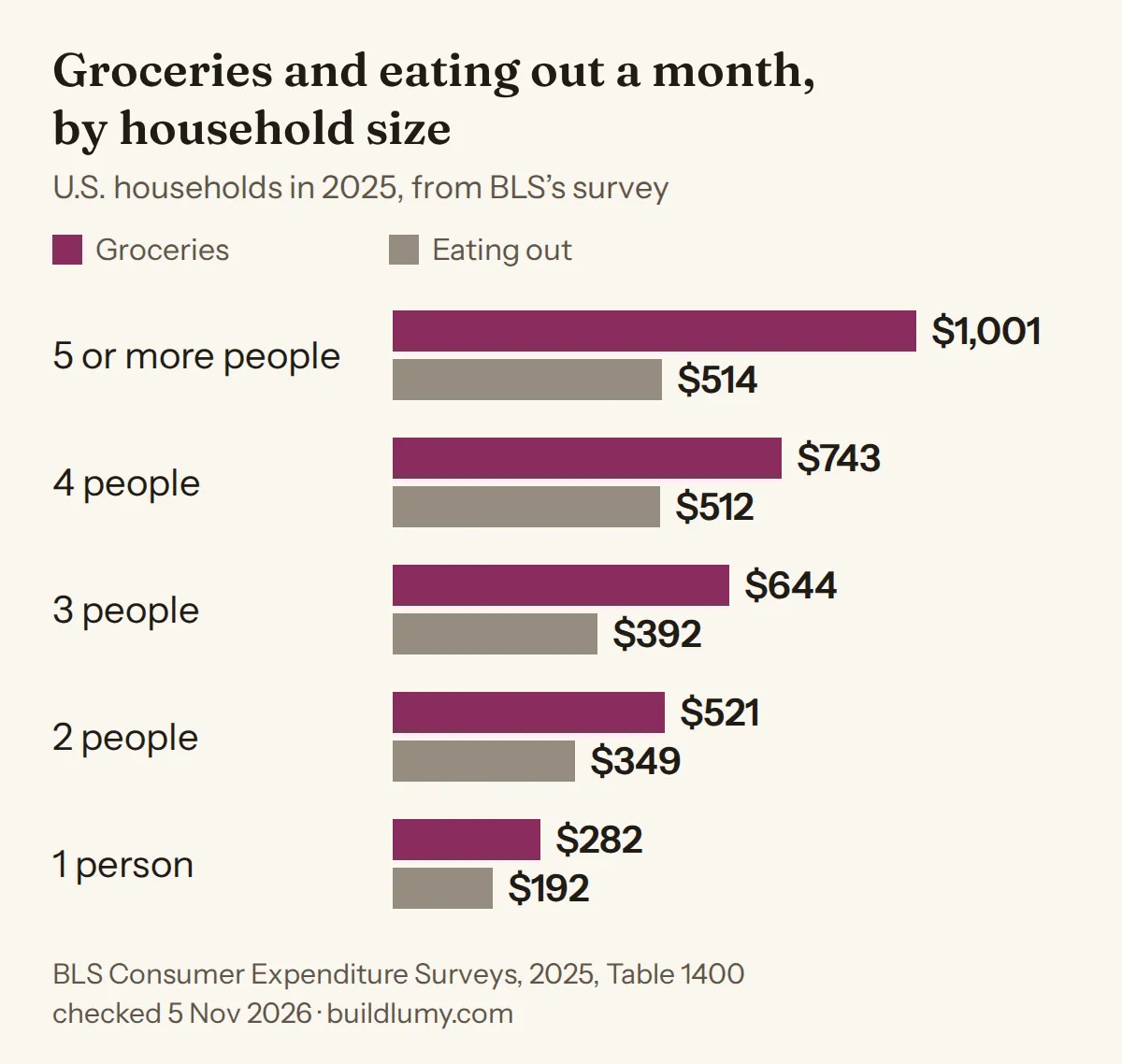
So if you live alone and your groceries come to around $300 a month, you're close to the U.S. average, and the table gives you the line for your own household.
Why every site gives a different number
If you've opened a few of these pages, you've probably seen it: each one has its own number, and Google's AI answer blends several of them into one wide range, with a pound sign slipped into two of its dollar figures. But they aren't all wrong, they're just measuring different things.
| Where you see it | Its number | What it really is |
|---|---|---|
| Instacart's guide (updated Oct 8, 2025) | about $365 a month per person | the USDA's moderate food plan for adults aged 20 to 50 in a four-person home of two men and two women; the same page also gives $390.20 for one man, $329.20 for one woman and an "average monthly recommended minimum" of $427.63, and its table runs from a low-cost budget to a liberal one |
| WalletHub (Oct 1, 2026) | $518.67 a month for "the average American" | BLS's 2024 groceries for a whole household, $6,224 a year, divided by 12; the same page also tells you to budget $504 |
| NerdWallet (updated Aug 13, 2026) | $1,013.20 a month that "the average family of four spends" | the price of the USDA's thrifty plan for two adults aged 20 to 50 and two children aged 6 to 8 and 9 to 11; its source list names a BLS price summary, not the USDA |
| Beehive Meals (Aug 1, 2025) | "more than $900 per month per person" | a survey's $235 a week, turned into a month and called per person, while the same page's FAQ calls $270.21 a week a household's figure |
| Google's AI answer (Nov 3, 2026) | $344 to $549 a month for one person | a range built from several sites, which also says the USDA has four tiers |
The biggest split is between a plan's price and what people actually spend. The USDA puts a monthly price on its food plans, from thrifty up to liberal as NerdWallet lists them, and a plan's price is what that plan's groceries would cost, not what families pay at the store. That's why NerdWallet's family of four costs more than the four-person households in BLS's survey actually spent.
Two more pages on Google's first page, a newspaper's and a budgeting app's, give ranges of a few hundred dollars for one adult, but neither page would open for this research, so only Google's preview of them could be checked.
Per household, not per person
And an average household isn't one person: in BLS's 2025 survey it holds 2.4 people, so a household's bill written as one American's makes that American look a lot hungrier than they are.
BLS's newest figure, for 2025, came out at the end of October 2026, and it's higher than 2024's: $6,491 a year for an average household.
What real grocery bills include
Averages are one thing, but what do real people say they pay? In one r/budget thread with 234 comments, people shared their bill, their household size and where they live, and the answers spread out a lot.
- One person: "$250-350 it hurts, 1 person, nova/washington dc"; "Single, 40M, small town Midwest. $300 to 350 per month."; "350-400 one person, Austin TX"; "Solo 45m is $70 per week."
- Two people: "Probably about $400 for two a month."; "About $500 per month for 2 people."; "$1100-$1200 for two in a relatively low cost of living area."
- Four people: "About $1200/month or $300/week. 4 people in the house."; "$1400/month for a family of 4 in the south."
And the bills don't hold the same things. That $1,400 includes "all toiletries including diapers, wipes, formula, cleaning supplies, TP, etc.", a two-person bill "Includes non-food items we buy at the grocery store like paper towels/toothpaste/toilet paper/etc", a family of four's includes wine, and another two-person bill leaves out "pet food/treats". BLS keeps alcohol, household supplies, pets and personal care on lines of their own, apart from groceries, which is one more reason a real bill can sit well above the table.
In a local community group, a family of five said they spend about $800 a month, because they shop the sales and stock up on what they use most.
And the question isn't new: back in 2020, someone on a personal finance Q&A site asked whether $603 a month for one person's food was high or normal.
How to compare your own grocery bill
Compare your grocery bill with the table
4 steps
The table can't tell you what you should spend, only what households like yours spent, so if your bill sits well above your row, start with the list above, and the budget itself is yours to set.
What couldn't be checked
The USDA's own monthly report wouldn't open for this research, so its food plans appear here only as the sites quote them. Google's preview of the USDA's page names a September 2026 report on food costs "at Three Levels", while NerdWallet lists four plans, and the USDA's own page is where that would be settled.
BLS's 2025 survey has a gap of its own, because the Census Bureau couldn't collect it in October and November 2025, during the federal shutdown, and BLS adjusted its weights to cover the missing months.
And the r/budget answers are from May 2024, and only the first 25 of the thread's comments were read, so they show how far real bills spread, not an average.
So next time a page tells you what the average American spends on groceries, check whose bill it is and what's in it, and then put your own next to the right row of the table.
Tags: groceries · budgeting · food costs